Physiotherapy Degree in Germany: Study Path and Career Opportunities
Physiotherapy is a healthcare profession focused on improving movement and function in people affected by injury, illness, or disability. Germany’s well-established healthcare system and strong academic reputation make it a popular destination for physiotherapy education, with diverse career paths in hospitals, rehabilitation centres, private clinics, and sports institutions.
Degree Structure: Vocational and Academic Routes
Germany runs a dual-track system for entering the profession. The vocational route (Ausbildung), typically three years at a specialised school, is the legal minimum qualification and remains the most common path into the profession; it is not expressed in ECTS credits. A parallel academic Bachelor’s route also exists at universities of applied sciences, usually spanning six to seven semesters and worth around 180–210 ECTS credits, placed at EQF Level 6. Some universities offer accelerated tracks for students who already hold the vocational qualification.
Both routes cover anatomy, physiology, and movement science, alongside therapeutic techniques. The academic route places additional emphasis on evidence-based practice and research skills.
Admission Requirements
Admission to the academic route typically requires the German Abitur or an equivalent secondary qualification recognised for German higher education; foreign qualifications are usually assessed through the Uni-Assist platform. Many universities also hold a selection test or interview. Programmes are offered in German or, at some institutions, in English — applicants need proof of proficiency in the language of instruction.
Clinical Training
Both routes require at least 1,600 hours of practical training in hospitals, private clinics, rehabilitation centres, and outpatient facilities, covering conditions ranging from musculoskeletal injuries to neurological disorders, under the supervision of experienced physiotherapists.
Costs and Living Expenses
Public universities generally charge no tuition for EU undergraduate students, only a modest semester fee covering administration and public transport. Private institutions charge higher fees in exchange for smaller class sizes and more flexible study formats. Living costs are relatively affordable compared to other Western European countries, though they vary by city. Scholarship programmes, including those from the German Academic Exchange Service, are available for international students in healthcare fields.
Licensing and Career Opportunities
Graduates of either route must pass a national licensing exam testing theoretical knowledge and practical competencies before practising as a licensed physiotherapist, in line with the recognition principles described in our Article 11 recognition guide. After licensing, physiotherapists can specialise in areas such as paediatric, sports, neurological, geriatric, or orthopaedic physiotherapy, often through postgraduate courses or a master’s degree.
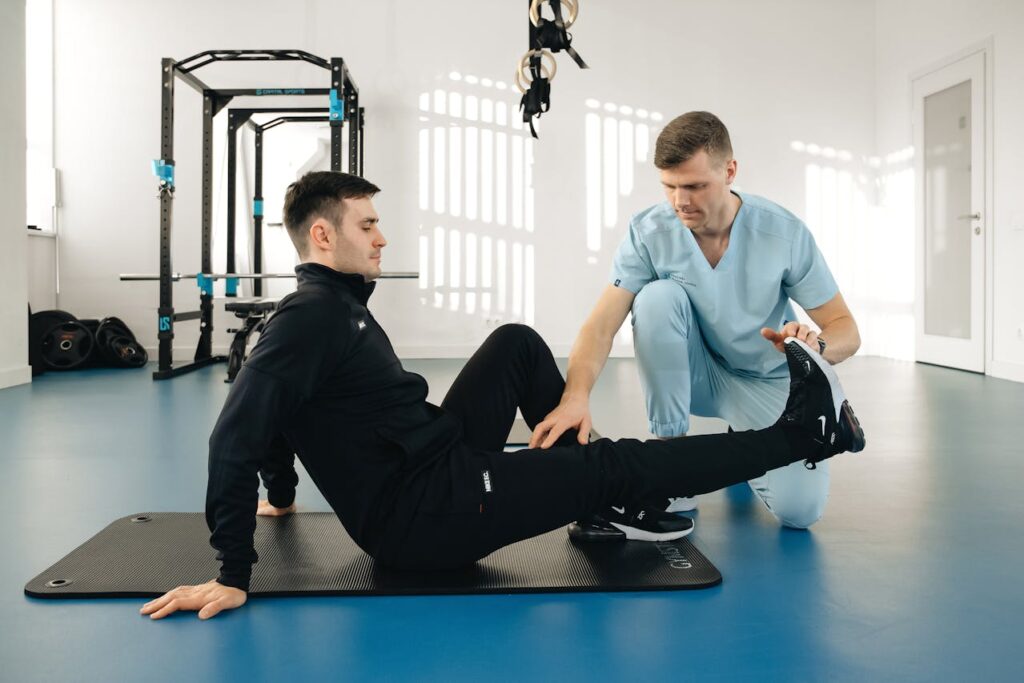
Graduates work across hospitals and multidisciplinary rehabilitation teams, private outpatient practices offering tailored musculoskeletal and pain management care, and rehabilitation centres focused on long-term recovery. Demand continues to grow alongside an ageing population and rising rates of chronic conditions, with additional career paths available in academia, research, and healthcare management for those pursuing further qualifications.
Where Can You Practice with a German Physiotherapy Degree?
Under Article 11 of Directive 2005/36/EC, the German physiotherapy qualification’s legal minimum entry level is Level (c) — the vocational route. A parallel academic bachelor’s route exists at Level (d), but it is not the statutory minimum, so recognition across the EU/EEA is assessed against Level (c) unless the holder has completed the academic route. As a result, acceptance varies depending on the host country’s own minimum requirement, and compensatory measures under Article 14 are considerably more likely for host countries requiring Level (d) or (e). For the full recognition procedure, see our Article 11 recognition guide.
Article 11 Recognition Table — Germany
| Article 11 Level | Description | Countries requiring this level | Recognition from Germany (c) |
|---|---|---|---|
| Level (e) | Master’s degree or post-graduate — university, more than 4 years | Belgium Cyprus France Iceland Luxembourg Poland EQF 7 — master’s degree required as minimum entry level | ✗ Not automatically accepted Two levels below host country requirement. Substantial compensatory measures under Art. 14 are likely, or a bachelor’s-level qualification (Level d, where held) may be required as a starting point. |
| Level (d) | Bachelor’s degree — university or higher education, 3–4 years | Austria Bulgaria Croatia Czechia Denmark Estonia Finland Greece Hungary Ireland Italy Latvia Lithuania Malta Netherlands Portugal Romania Slovenia Spain Sweden Norway EQF 6 — bachelor’s degree, 180–240 ECTS | ⚠ Accepted only via the academic route Germany’s vocational-level qualification (c) does not by itself meet this requirement. Holders of the parallel German bachelor’s degree (also Level d) are assessed on equal footing with other Level (d) countries. |
| Level (c) ← Germany | Post-secondary / short-cycle vocational training (min. 1 year) | Germany Slovakia Dual-track systems: vocational route is the legal minimum; academic route also exists at level (d) | ✓ Accepted Same level — qualification accepted. Individual compensatory measures may still apply per host country rules. |
| Level (b) | Secondary education certificate or vocational training | No EU/EEA country requires only level (b) for physiotherapy | ✓ Accepted Not applicable for physiotherapy in the EU/EEA. |
| Level (a) | Attestation of competence — basic training or general education | No EU/EEA country requires only level (a) for physiotherapy | ✓ Accepted Not applicable for physiotherapy in the EU/EEA. |