Oncology in physiotherapy degree programs across Europe prepares graduates to support patients throughout cancer treatment and recovery, from managing treatment-related side effects to restoring function and mobility after surgery or chemotherapy. As a subject, oncology is an increasingly important clinical component in physiotherapy degree programs across Europe, reflecting the growing role of rehabilitation in cancer care pathways. According to the European Commission’s mapping of physiotherapy education, oncology appears in the curriculum of 23 out of 28 surveyed countries as a clinical sciences subject, with a similar pattern in interventional skills training.
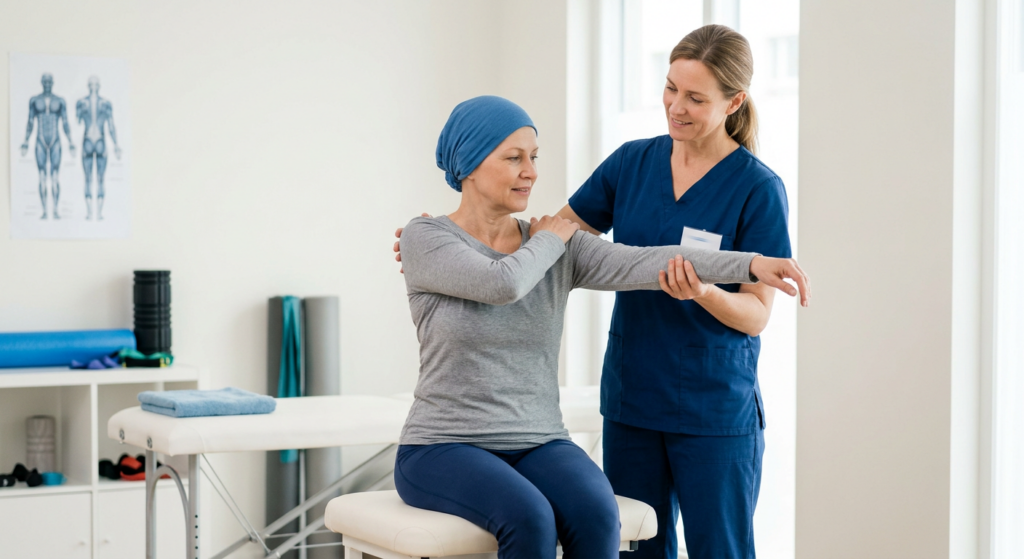
Where Oncology Is Taught Within Physiotherapy Degree Programs Across Europe
Oncology appears in most European physiotherapy curricula, though universities structure it differently depending on national regulation and programme length. In some countries it stands as a dedicated clinical subject with matching interventional training; in others, it remains partially integrated into broader internal medicine or rehabilitation modules.
- Germany, Italy and Romania: The only surveyed countries that do not include oncology — neither as a clinical sciences subject nor as an interventional skill — in the minimum entry-level curriculum. That said, students in these countries may still encounter oncology-related cases during broader clinical placements or postgraduate specialisation.
- Bulgaria and Slovakia: Both teach oncology as an interventional skill but do not include it as a distinct clinical sciences subject.
- Ireland: Oncology is not treated as a standalone subject requirement, but universities typically embed it as a component within a wider clinical module.
- France, Belgium, Poland, Luxembourg (300 ECTS master’s level): Students study oncology in greater depth, covering advanced cancer rehabilitation, lymphoedema management and palliative-stage physiotherapy.
- Austria, Denmark, Finland, Greece, Hungary: Universities integrate oncology closely with internal medicine and rehabilitation, often reinforced through clinical placements in hospital oncology and palliative care units.
What Cancer Rehabilitation Training Covers
This subject builds on musculoskeletal sciences and connects closely with rehabilitation. Overall, most European programs cover the following core areas:
- Physiological effects of cancer and cancer treatment on the body
- Pre- and post-operative rehabilitation for oncology patients
- Management of lymphoedema and treatment-related fatigue
- Exercise prescription during and after cancer treatment
- Palliative and end-of-life physiotherapy care
Clinical Placements and Competence in This Field
Cancer survivorship has grown substantially across Europe, making oncology an increasingly relevant area of physiotherapy practice. Therefore, dedicated training in this field carries growing weight in the oncology component of physiotherapy degree programs across EU/EEA countries. Graduates apply their theoretical knowledge directly with patients during clinical placements, most commonly in hospital oncology wards, rehabilitation centres and palliative care units. In addition, this clinical exposure works alongside competences already covered under rehabilitation and pain medicine, since oncology patients frequently require both functional recovery and pain management strategies.
Countries Where This Subject Is Included in the Physiotherapy Curriculum
Oncology forms part of the minimum entry-level curriculum in most surveyed countries, with Germany, Italy and Romania as exceptions. Bulgaria and Slovakia follow a partial pattern, covering the subject only through interventional skills training.
*Bulgaria and Slovakia cover oncology as an interventional skill but not as a distinct clinical sciences subject. Germany, Italy and Romania are not listed above, as none of the three countries includes oncology in either form within the minimum entry-level curriculum.
If you are exploring where to study, browse our country guides to compare access requirements, ECTS credits and clinical placement structures for each physiotherapy degree program in Europe.