Physiotherapy Degree in Belgium: Study Path and Career Opportunities
Physiotherapy is a healthcare profession focused on improving mobility, managing pain, and supporting recovery across all ages. Belgium blends academic rigour with extensive practical training, and its multilingual environment — Dutch, French, and German — gives students exposure to a culturally diverse clinical setting.

Degree Structure and ECTS Credits
The minimum entry-level qualification for physiotherapy in Belgium is a master’s degree, placed at EQF Level 7 — a higher entry requirement than most other EU countries, which typically require a bachelor’s degree. ECTS credit requirements vary slightly by community: the Flemish-speaking community requires 300 ECTS, while the French-speaking community requires 240 ECTS.
The curriculum covers anatomy, physiology, and biomechanics early on, moving into musculoskeletal, neurological, and cardiovascular physiotherapy in later years, with a strong emphasis on evidence-based practice. Supervised internships in hospitals, private clinics, and rehabilitation centres run throughout the programme, culminating in extensive clinical placements and, often, a research project in the final year.
Admission Requirements
Admission requires a secondary school diploma recognised by Belgian institutions; international students typically need their credentials formally evaluated. Some institutions also hold entrance exams covering biology, chemistry, and physics. Proficiency in the language of instruction — Dutch, French, or German depending on the region — is mandatory.
Costs and Financial Support
Tuition in Belgium is relatively affordable compared to other Western European countries, particularly for EU students. International students may access institutional scholarships, Erasmus+ funding, or government schemes such as VLIR-UOS for students from developing countries. Part-time work is generally permitted during studies, subject to regulated limits.
Career Opportunities
Belgium’s healthcare system offers strong demand for physiotherapists across hospitals, rehabilitation centres, private clinics, and sports medicine facilities, as well as specialised areas such as paediatrics and geriatrics. Physiotherapists typically work within multidisciplinary teams alongside doctors, nurses, and occupational therapists.
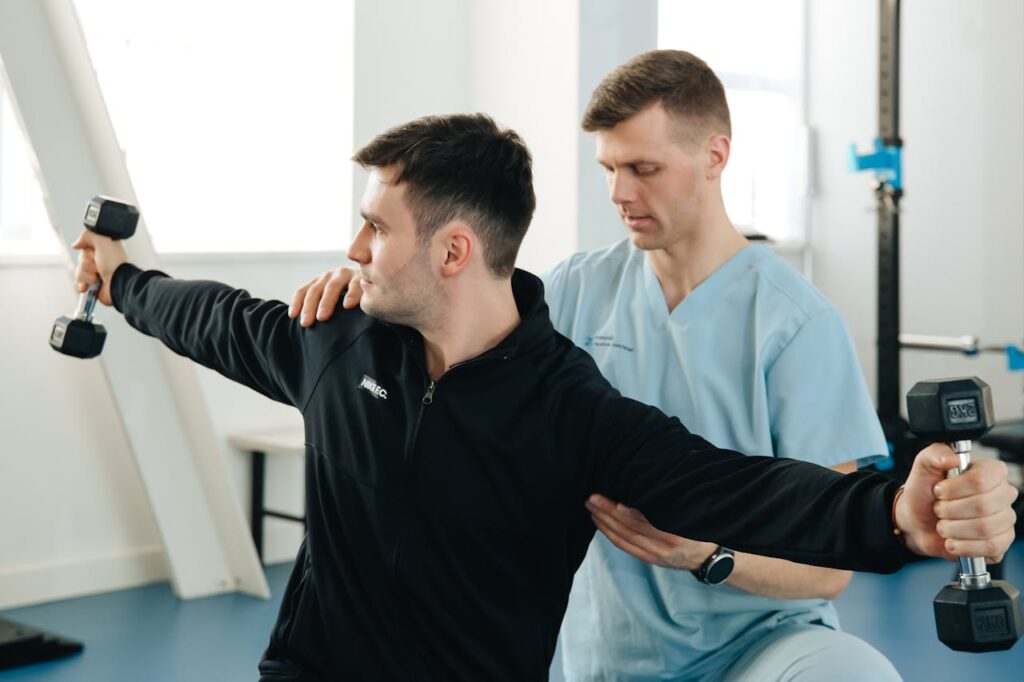
Graduates can further specialise in areas such as neurological rehabilitation or musculoskeletal therapy through additional certifications, and continuing professional development is expected throughout a physiotherapist’s career. Doctoral study is also available for those interested in research or academia, in line with the recognition principles described in our Article 11 recognition guide.
Where Can You Practice with a Belgian Physiotherapy Degree?
Under Article 11 of Directive 2005/36/EC, the Belgian physiotherapy qualification is a master’s degree and qualifies as Level (e) — the highest recognition tier under the Directive. As a result, it meets or exceeds the minimum entry requirement of every EU/EEA country, since no country requires more than a master’s-level qualification for physiotherapy. This does not remove the need for registration, language proof, or other formalities in the host country. For the full recognition procedure, see our Article 11 recognition guide.
Article 11 Recognition Table — Belgium
| Article 11 Level | Description | Countries requiring this level | Recognition from Belgium (e) |
|---|---|---|---|
| Level (e) ← Belgium | Master’s degree or post-graduate — university, more than 4 years | Belgium Cyprus France Iceland Luxembourg Poland EQF 7 — master’s degree required as minimum entry level | ✓ Accepted Same level — qualification accepted. Individual compensatory measures may still apply per host country rules. |
| Level (d) | Bachelor’s degree — university or higher education, 3–4 years | Austria Bulgaria Croatia Czechia Denmark Estonia Finland Greece Hungary Ireland Italy Latvia Lithuania Malta Netherlands Portugal Romania Slovenia Spain Sweden Norway EQF 6 — bachelor’s degree, 180–240 ECTS | ✓ Accepted Belgium’s level (e) exceeds the minimum required. Qualification is fully accepted, though standard registration formalities still apply. |
| Level (c) | Post-secondary / short-cycle vocational training (min. 1 year) | Germany Slovakia Dual-track systems: vocational route is the legal minimum; academic route also exists at level (d) | ✓ Accepted Belgium’s level (e) exceeds the minimum. Individual assessment by the competent authority may apply due to the dual-track system. |
| Level (b) | Secondary education certificate or vocational training | No EU/EEA country requires only level (b) for physiotherapy | ✓ Accepted Not applicable for physiotherapy in the EU/EEA. |
| Level (a) | Attestation of competence — basic training or general education | No EU/EEA country requires only level (a) for physiotherapy | ✓ Accepted Not applicable for physiotherapy in the EU/EEA. |